
Local Outlier Factor on the GPU.
Exact LOF scores, matching scikit-learn's sign conventions,
for the fit_predict workflow.


- from sklearn.neighbors import LocalOutlierFactor as LOF
+ from culof import LOF

  labels = LOF(n_neighbors=20, contamination=0.01).fit_predict(X)
That transductive workflow — score every point against the dataset it came
in with — is the one cuLOF covers, with the same sign conventions and the same
negative_outlier_factor_ and offset_ attributes.
It is not a drop-in replacement for the estimator. algorithm,
leaf_size, metric, p, metric_params, novelty and n_jobs are not
accepted; sparse and precomputed input are not supported; and get_params,
set_params, kneighbors and decision_function do not exist, so it will not
go into a Pipeline or a grid search. There is no novelty mode: predict and
score_samples operate on the fitted data only.
Agreement on what it does cover is close rather than exact — see Accuracy for the measured distribution and where float32 ties can move a score.
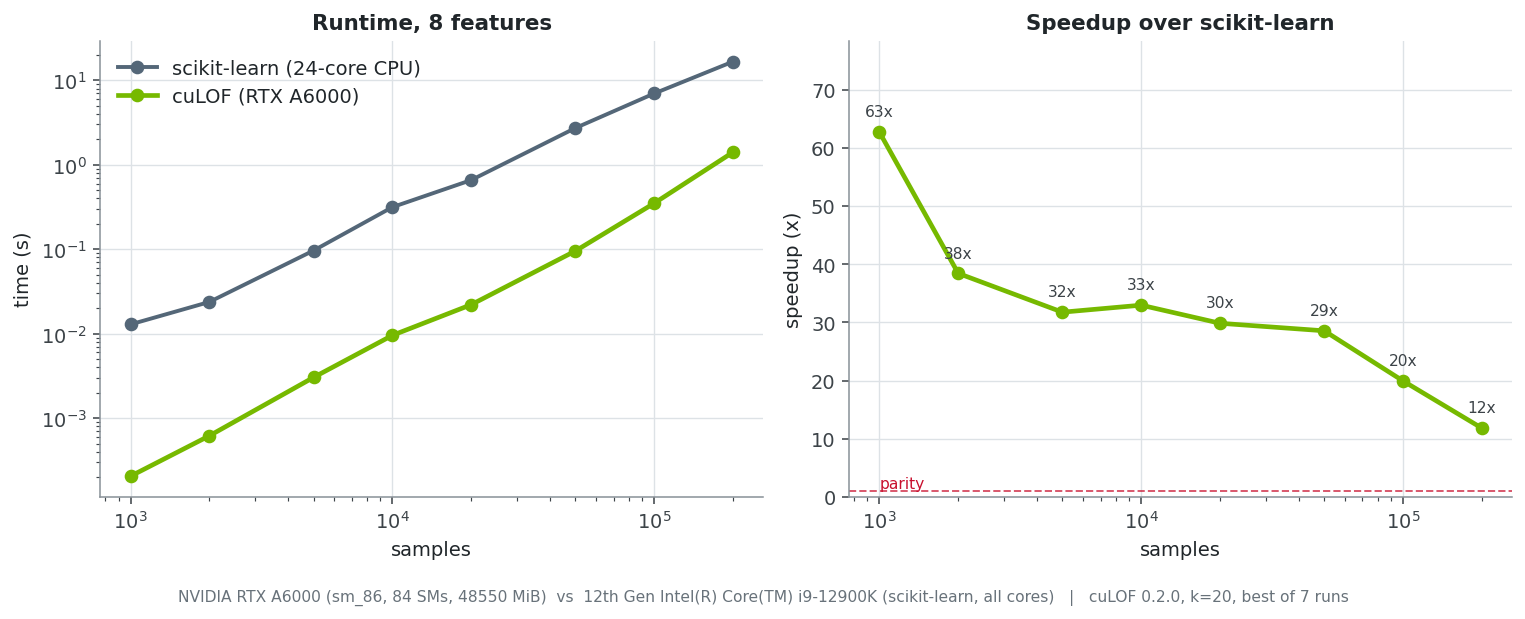
| samples | scikit-learn | cuLOF | speedup |
|---|---|---|---|
| 1,000 | 0.013 s | 0.0002 s | 63× |
| 5,000 | 0.096 s | 0.0030 s | 32× |
| 20,000 | 0.659 s | 0.0221 s | 30× |
| 50,000 | 2.723 s | 0.0953 s | 29× |
| 200,000 | 16.66 s | 1.409 s | 12× |
RTX A6000 vs 24-thread i9-12900K, 8 features, k=20, best of 7 runs, one-time CUDA context initialisation excluded. Reproduce with:
python benchmarks/benchmark.py --max-n 200000 --json bench.jsonEvery row is also checked against scikit-learn in the same run — a speedup on a wrong answer is not a speedup.
Distances are one GEMM. Expanding ‖a-b‖² = ‖a‖² + ‖b‖² - 2a·b turns the
O(n²d) distance computation into a single cuBLAS SGEMM, which runs at a large
fraction of peak FP32 instead of the few percent a hand-written distance loop
reaches. The identity is numerically delicate — it cancels when ‖a‖² dwarfs
‖a-b‖² — so cuLOF centres the data first, which leaves every distance
unchanged while making that term as small as it can be.
k-NN by selection, not sorting. LOF needs the set of k neighbours and the k-distance; it never needs them ordered. So cuLOF selects. For non-negative IEEE-754 floats the integer ordering of the bit pattern is the numeric ordering, so a radix select on the raw bits is exact — and the k-th key it produces is the k-distance, for free. Three passes of 11 bits pin it down; a fourth gathers the neighbours.
| insertion sort (before) | radix select (now) | |
|---|---|---|
| maximum k | 32, a fixed register array | unbounded |
| work per row | O(n·k) | O(n) per pass |
| memory access | stride-n across lanes | fully coalesced |
The n×n matrix is never materialised. Rows are processed in tiles sized to free device memory, so memory grows linearly in n for fixed k. The neighbour arrays are a separate O(n·k). At n = 200,000 a dense float32 distance matrix would be 149 GiB.
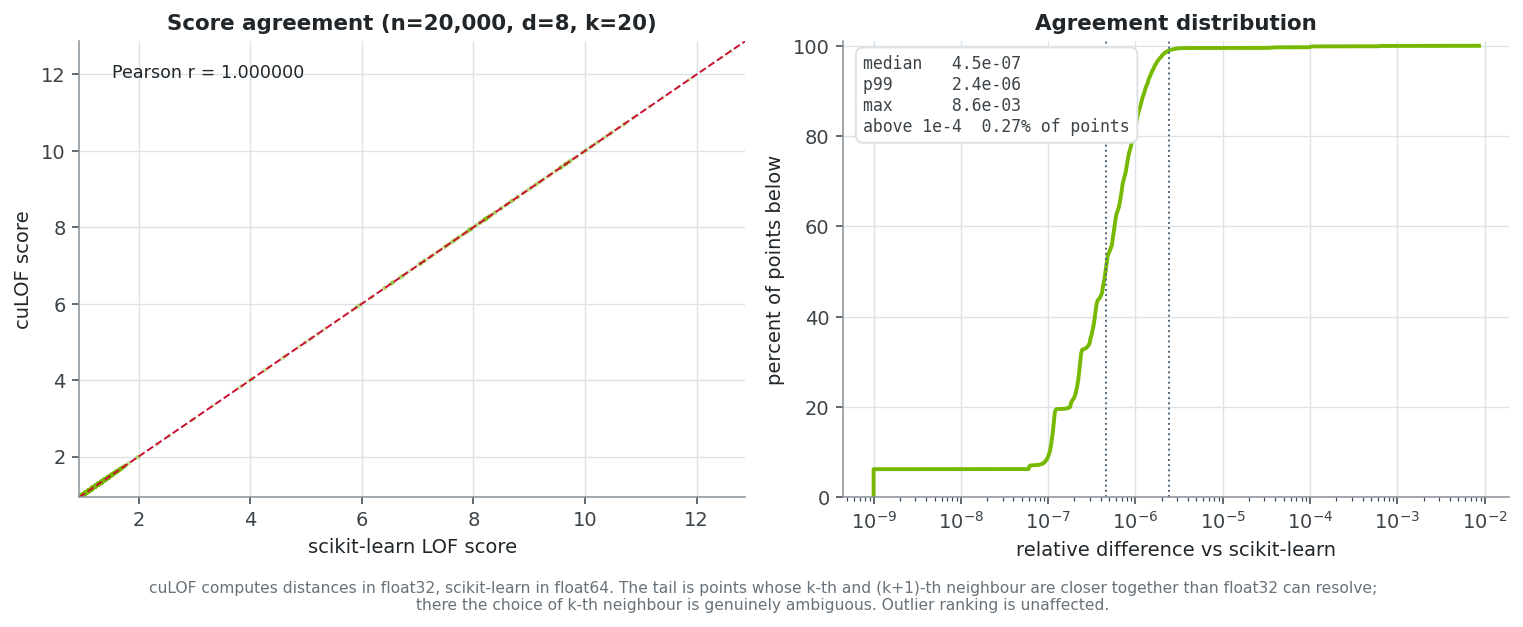
cuLOF computes distances in float32 and scikit-learn in float64, so agreement is measured rather than assumed. At n = 20,000, d = 8, k = 20: median relative difference 4.5×10⁻⁷, 99th percentile 2.4×10⁻⁶, and identical top-1% rankings in every benchmarked configuration.
The tail belongs to points whose k-th and (k+1)-th neighbours are closer
together than float32 can resolve. There, which neighbour is "the k-th" is
genuinely ambiguous and the two libraries may choose differently; that point's
score can move by up to ~1%. This affects 0.27% of points, and never changed
which points were flagged.
test_near_ties_are_the_only_disagreement asserts
exactly this.
pip install culofNeeds a CUDA toolkit (11.0+) with nvcc on PATH, CMake 3.18+, and an NVIDIA
GPU of compute capability 7.0 or newer. The build detects your GPU's
architecture automatically. See docs/install.md for offline
builds, fat binaries, and troubleshooting.
from culof import LOF, lof

# The estimator: mirrors sklearn.neighbors.LocalOutlierFactor
model = LOF(n_neighbors=20, contamination="auto", normalize=False)
labels = model.fit_predict(X)  # -1 outlier, 1 inlier
model.negative_outlier_factor_  # negated LOF, sklearn's convention
model.offset_  # the threshold predict() applies

# The function: the LOF value itself, ~1.0 for a normal point
scores = lof(X, k=20)
k has no upper bound beyond n_samples - 1. The selection scan is
independent of k, but neighbour indices and distances are O(n·k) and both
downstream kernels loop over all k, so large k does cost time and memory. At
k = 20 the O(n²d) distance stage dominates and moderate changes to k barely
register. Full walkthrough in docs/usage.md.
- Brute force. cuLOF computes all n² distances (measured: n^1.94 over n ≥ 50,000). scikit-learn uses a KD-tree in low dimensions, which never looks at most pairs (n^1.31 over the same range). Better asymptotics beat a constant hardware factor eventually, so the low-dimensional speedup decays as roughly n^-0.64. This is dimension-specific: at d = 128, where KD-trees collapse and scikit-learn falls back to brute force, both scale as n^1.9 and the ratio is flat at ~15× from n = 5,000 to 100,000. Treat ~15× as the steady-state hardware win and the low-d figures as additionally reflecting tree-build overhead scikit-learn pays and cuLOF does not. Measured tables and the reasoning.
- Below ~1,000 points, the one-off ~110 ms CUDA context initialisation dominates and scikit-learn is the better tool.
- Transductive, exactly like scikit-learn's: it scores the set it is given.
There is no
predictfor unseen points. - float32 only, with the precision boundary characterised above.
| docs/install.md | Requirements, architectures, troubleshooting |
| docs/usage.md | Choosing k, interpreting scores, migration |
| docs/implementation.md | Algorithm, kernels, determinism, memory |
| CONTRIBUTING.md | Development, testing, benchmarking |
| CHANGELOG.md | Release history |
pip install -e ".[test]" && pytest tests/python     # needs a GPU
cmake -B build -DCULOF_BUILD_TESTS=ON && cmake --build build -j
./build/culof_tests
The C++ suite checks every stage against an independent double-precision CPU implementation of LOF; the Python suite checks agreement with scikit-learn and carries one regression test per defect that shipped in an earlier release.
Breunig, Kriegel, Ng, Sander. LOF: Identifying Density-Based Local Outliers. SIGMOD 2000.
MIT — see LICENSE.