Draw an ER diagram of your schema: tables, columns (with types), primary and foreign keys, and the relationships between them.
Suggested tool: dbdiagram.io — free, fast, and made for ER diagrams.
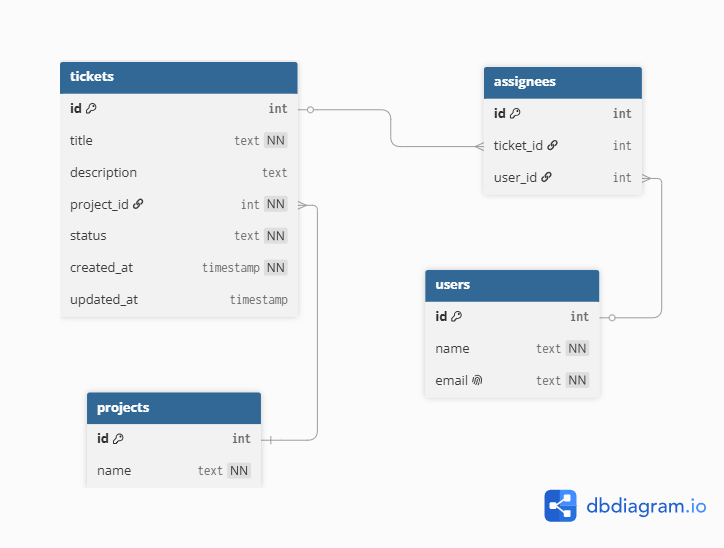
| Method | Path | Description |
|---|---|---|
| POST | /users | Create a new user |
| GET | /users | Get all users |
| GET | /users/{userId} | Get a single user by ID |
| PUT | /users/{userId} | Update an existing user |
| DELETE | /users/{userId} | Delete a user by ID |
| GET | /projects | Get all projects with ticket counts per status |
| POST | /tickets | Create a new ticket |
| GET | /tickets | Get all tickets, with optional filters by title, description, or status |
| GET | /tickets/{ticketId} | Get a single ticket by ID |
| PUT | /tickets/{ticketId} | Update a ticket |
| POST | /tickets/{ticketId}/assignees | Assign a user to a ticket |
| DELETE | /tickets/{ticketId}/assignees/{userId} | Remove a user from a ticket |
Create a new user.
| Endpoint | /users |
| Method | POST |
| Request body | { "name": "string", "email": "string" } |
| Response body | { "id": 1, "name": "string", "email": "string" } |
| Validations | Name is required. Name must be at least 3 characters. Email is required. Email must be valid. Email must be unique. |
Return all users.
| Endpoint | /users |
| Method | GET |
| Request body | |
| Response body | [ { "id": 1, "name": "string", "email": "string" } ] |
| Validations |
Get a single user by ID.
| Endpoint | /users/{userId} |
| Method | GET |
| Request body | |
| Response body | { "id": 1, "name": "Salem", "email": "salem@example.com" } |
| Validations | User must exist. |
Update an existing user.
| Endpoint | /users/{userId} |
| Method | PUT |
| Request body | { "name": "Salem Updated", "email": "salem2@example.com" } |
| Response body | { "message": "User updated successfully" } |
| Validations | User must exist. Name minimum 3 characters. Email must be valid. Email must be unique. |
Delete a user by ID.
| Endpoint | /users/{userId} |
| Method | DELETE |
| Request body | |
| Response body | { "message": "User deleted successfully" } |
| Validations | User must exist. |
Return all projects with ticket counts per status.
| Endpoint | /projects |
| Method | GET |
| Request body | |
| Response body | [ { "id": 1, "name": "Project A", "open": 10, "inProgress": 5, "closed": 30 } ] |
| Validations |
Create a new ticket.
| Endpoint | /tickets |
| Method | POST |
| Request body | { "title": "Server not responding", "description": "Production server unreachable", "projectId": 1 } |
| Response body | { "message": "Ticket created successfully" } |
| Validations | Title is required. Title minimum 3 characters. Project must exist. Status is set automatically to open. |
Get all tickets. Supports optional filters via query string.
GET /tickets?status=open&text=server
| Endpoint | /tickets |
| Method | GET |
| Request body | |
| Response body | [ { "id": 1, "title": "Critical Bug in login flow", "description": "Users are getting a 500 error on the login screen.", "status": "open", "projectId": 1, "createdAt": "2026-06-12T12:00:00Z", "updatedAt": null, "assignees": [ { "id": 10, "name": "Salem" }, { "id": 11, "name": "Ali" } ] } ] |
| Validations | Status must be a valid value: open, in progress, or closed. |
Get a single ticket by ID.
| Endpoint | /tickets/{ticketId} |
| Method | GET |
| Request body | |
| Response body | { "id": 1, "title": "Server not responding", "description": "description", "status": "open", "projectId": 1, "createdAt": "2026-06-12T12:00:00", "updatedAt": null, "assignees": [ { "id": 1, "name": "Salem", "email": "salem@example.com" }, { "id": 3, "name": "Max", "email": "max@example.com" } ] } |
| Validations | Ticket must exist. |
Update a ticket.
| Endpoint | /tickets/{ticketId} |
| Method | PUT |
| Request body | { "title": "Server down", "description": "Updated description", "status": "IN_PROGRESS", "projectId": 1 } |
| Response body | { "message": "Ticket updated successfully" } |
| Validations | Ticket must exist. Status must be a valid value: OPEN, IN_PROGRESS, or CLOSED. Project must exist. updatedAt is set automatically. |
Assign a user to a ticket.
| Endpoint | /tickets/{ticketId}/assignees |
| Method | POST |
| Request body | { "userId": 5 } |
| Response body | { "message": "Assignee added successfully" } |
| Validations | Ticket must exist. User must exist. User must not already be assigned. |
Remove a user from a ticket.
| Endpoint | /tickets/{ticketId}/assignees/{userId} |
| Method | DELETE |
| Request body | |
| Response body | { "message": "Assignee removed successfully" } |
| Validations | Ticket must exist. User must exist. Assignment must exist. |
- When is an email sent? Every time a ticket is updated.
- Who receives it? All users currently assigned to that ticket.
- What does the email contain? The ticket ID, title, description, status, and current assignees.
- What happens if sending fails? The request still succeeds. The failure is logged to the console.