perf(expressions): sparse @/dot drops zero-coeff terms; vectorise densify_terms (#748) - #939
Conversation


Merging this PR will regress 1 benchmark
Warning Please fix the performance issues or acknowledge them on CodSpeed. Performance Changes
Tip Investigate this regression by commenting Comparing 
Footnotes
|

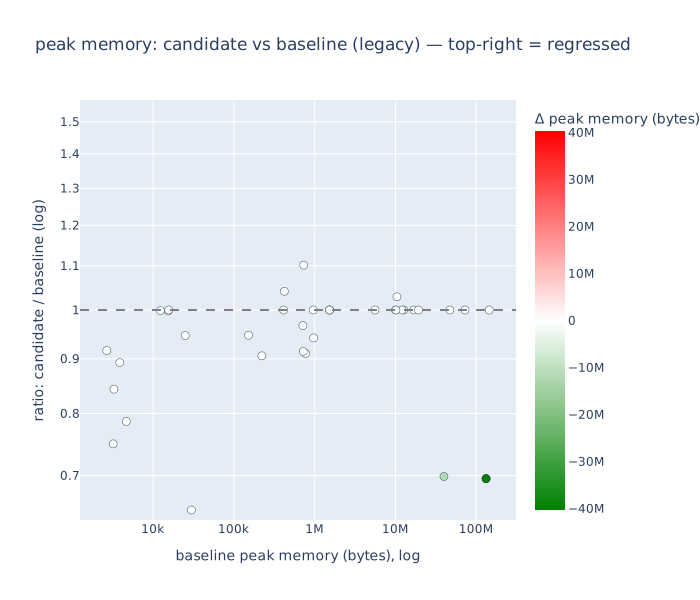
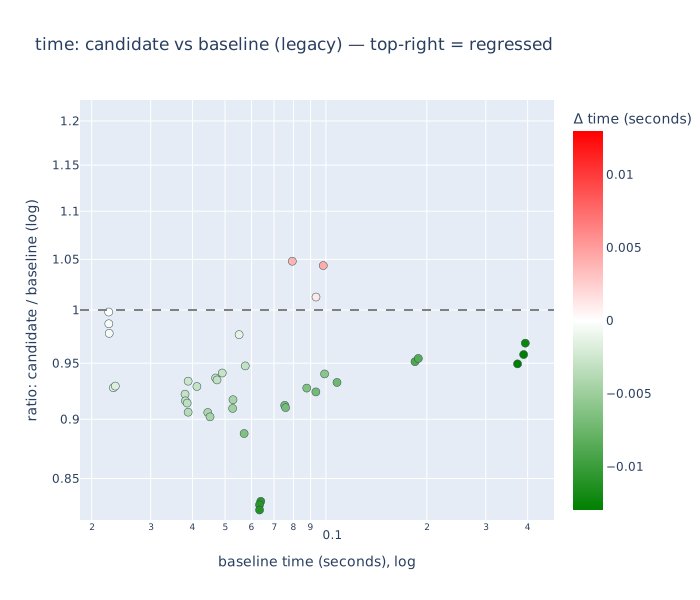
Build cost — v1 vs legacyv1 build peak & time relative to legacy, on this commit — not a comparison against master (that is CodSpeed).
Full table (time + peak, mean)📊 Interactive plots + CSV: download the semantics-report-v1-vs-legacy artifact from this run. Report-only · not a gate · refreshed on every push · obsolete once legacy is dropped. |

…e densify_terms (#748)

LinearExpression.__matmul__ against a constant matrix that holds zeros
densified the result to one term per contracted member. The bare @ now
compacts the term dimension to the widest non-zero cell via densify_terms,
under both legacy and v1 semantics; a zero-free constant is untouched. On
PyPSA's Kirchhoff Voltage Law constraint this cuts 852 terms to 3.

densify_terms is rewritten: it counted non-zero positions with a Python
loop that scaled quadratically and allocated the output at the full term
width. It is now vectorised, allocates only the compacted width, returns
self when no zeros are present, works on QuadraticExpression, and no longer
raises on expressions without coordinate dimensions.
…action zero operand (#748)

Rename the __matmul__ local `is_constant` to `other_is_const` so it no longer
shadows the imported `is_constant` helper and the `LinearExpression.is_constant`
property, which carry the unrelated "no variables present" meaning.

Add a regression test for `variable @ vector` that contracts away every coord
dim with a zero-containing operand, the scalar-dot shape the other matmul tests
did not exercise.

5386ff9 to
da73f9b
Compare
1 participant

Closes #748.
The sparse
@/dotpath was blowing up the term dimension on PyPSA's KVL constraint, anddensify_termsitself was quadratic. This fixes both.Note
The following content was generated by AI.
Changes proposed in this Pull Request
Sparse
@/dotno longer densifies (#748).LinearExpression.__matmul__computed(self * other).sum(dim=common_dims), which stacks every contracted member into the term dimension, even where the constant matrix is zero. Against a sparse constant (mostly zeros) this produced one term per member. The matmul now compacts the zero-coefficient terms viadensify_termswhenever the constant operand contains zeros, under both legacy and v1 semantics. A zero-free constant is untouched, so dense matmuls carry no overhead.merge.densify_termsrewritten. The old implementation counted non-zero positions with a Python loop that scaled quadratically in the number of non-zero terms, and allocated the compacted output at the full original term width. It is now fully vectorised, allocates only the compacted width, and returns the expression unchanged when it holds no zeros.IndexErroron expressions without coordinate dimensions (expr.sum(drop_zeros=True)over all dimensions), which the new sparse@path made reachable via an all-zero constant.QuadraticExpression, where it previously indexed the_factoraxis as the term axis.Tests. New cases in
test/test_linear_expression.pycover: sparse operand compacts, dense operand untouched, all-zero operand yields the zero expression, in-order row compaction, no-op when zero-free, scalar/all-zerodrop_zeros, and the quadratic path.Checklist
AGENTS.md).doc.doc/release_notes.rstof the upcoming release is included.