


python-first web applications with a shadcn/ui-based react renderer.
shadlet is a framework that lets developers build modern web applications in python. react renders the interface with shadlet's shadcn/ui-based components and base ui primitives. python manages application state, events, routing and server-side logic. end users run applications with python only; node.js is needed only to build the renderer or an extension bundle.
shadlet 0.7.0 is a focused performance and verification release. the renderer lazy-loads chart, calendar/date picker, and carousel adapters, reducing the main entry chunk from ~1,590kB to ~1,060kB minified (~483kB to ~328kB gzip). a generated component compatibility matrix and automated bundle budgets keep release claims checkable in CI. protocol v2 is maintained with source compatibility for 0.6.x applications. see the changelog and migration guide for details.
warning shadlet 0.7.0 does not claim complete parity with the current shadcn/ui catalogue. see the component catalogue and compatibility matrix for the supported and partial set.
note the auth and crud templates are local demonstrations; they do not provide production authentication, authorization, or database persistence.
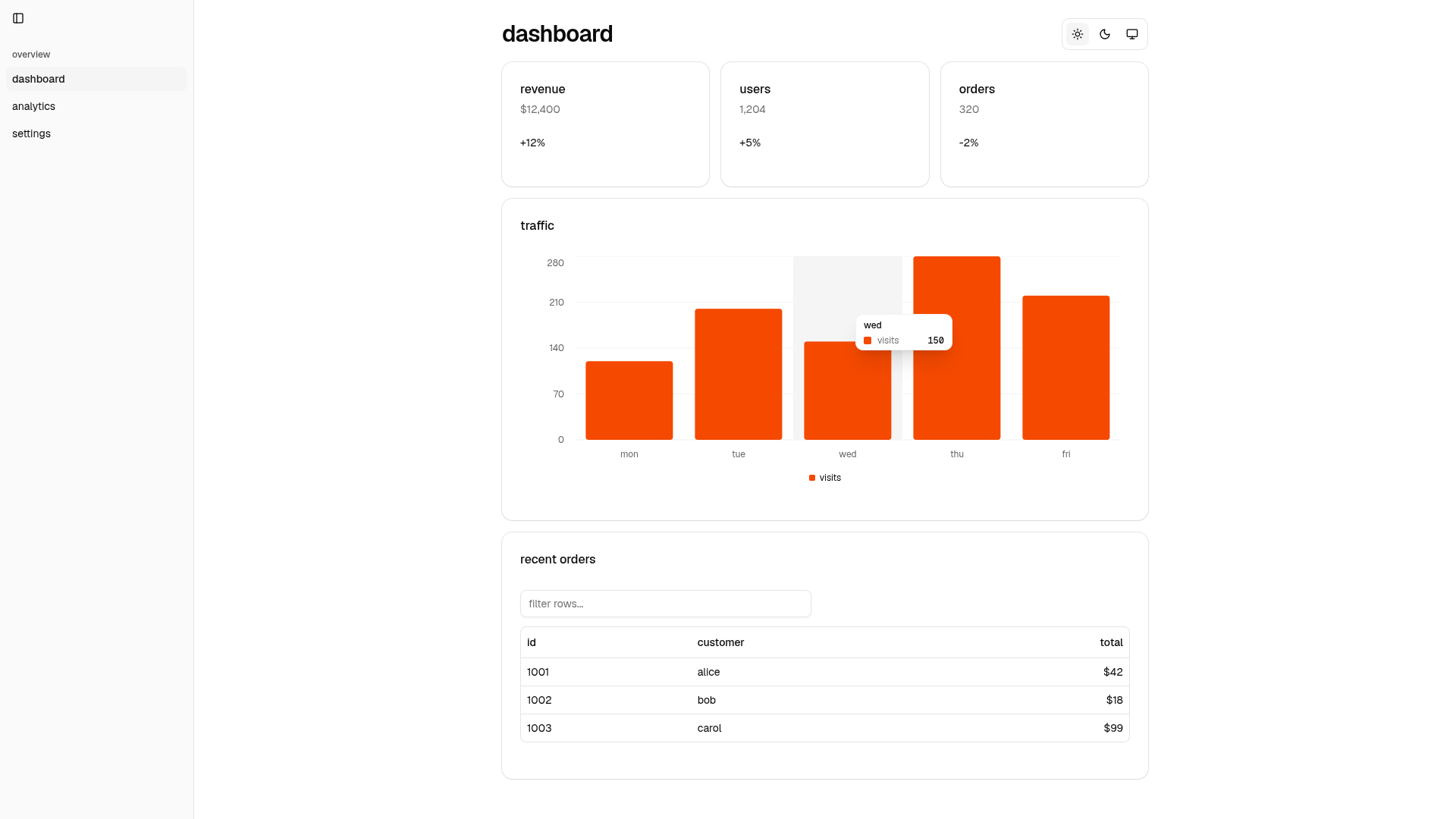
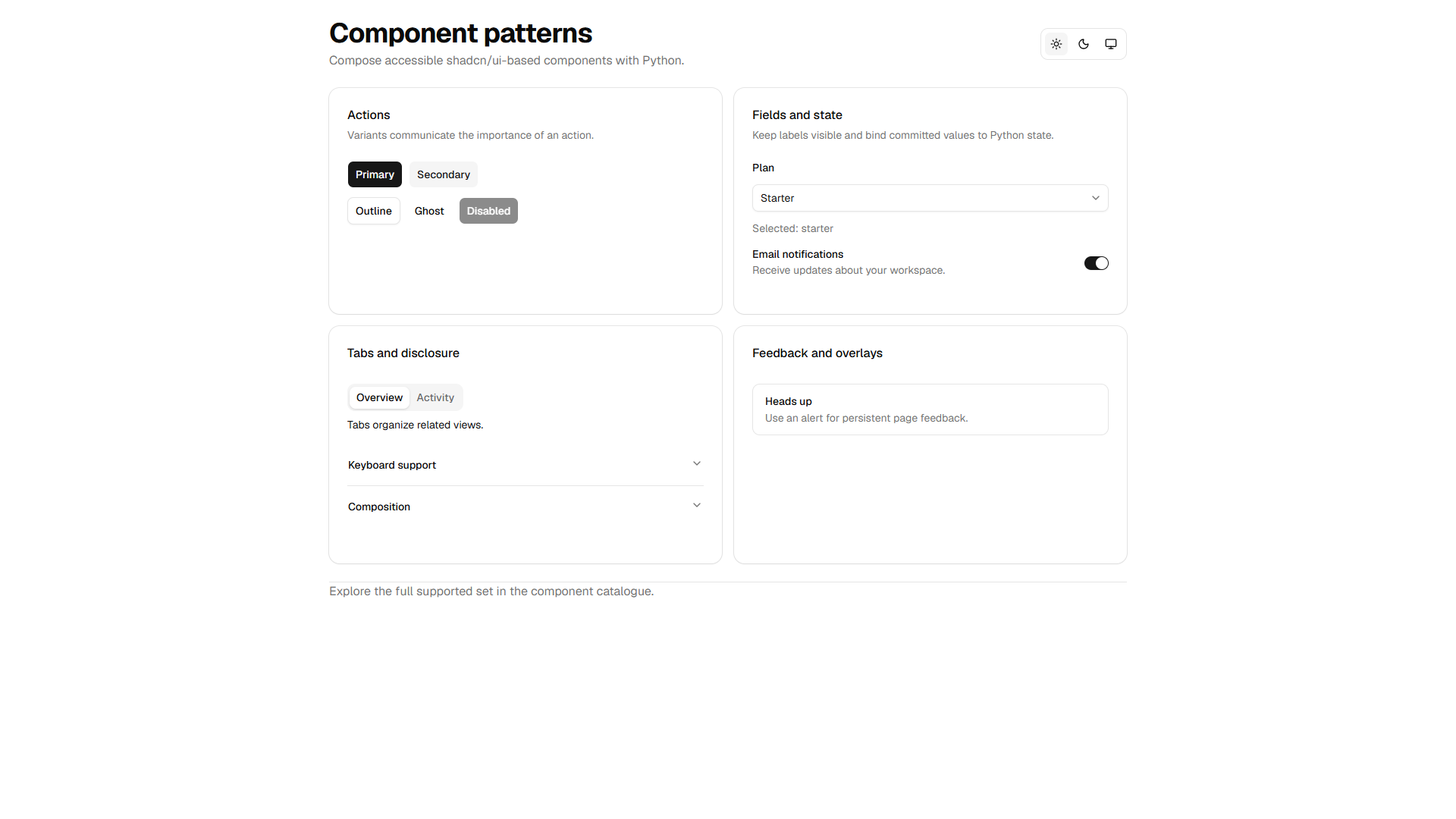
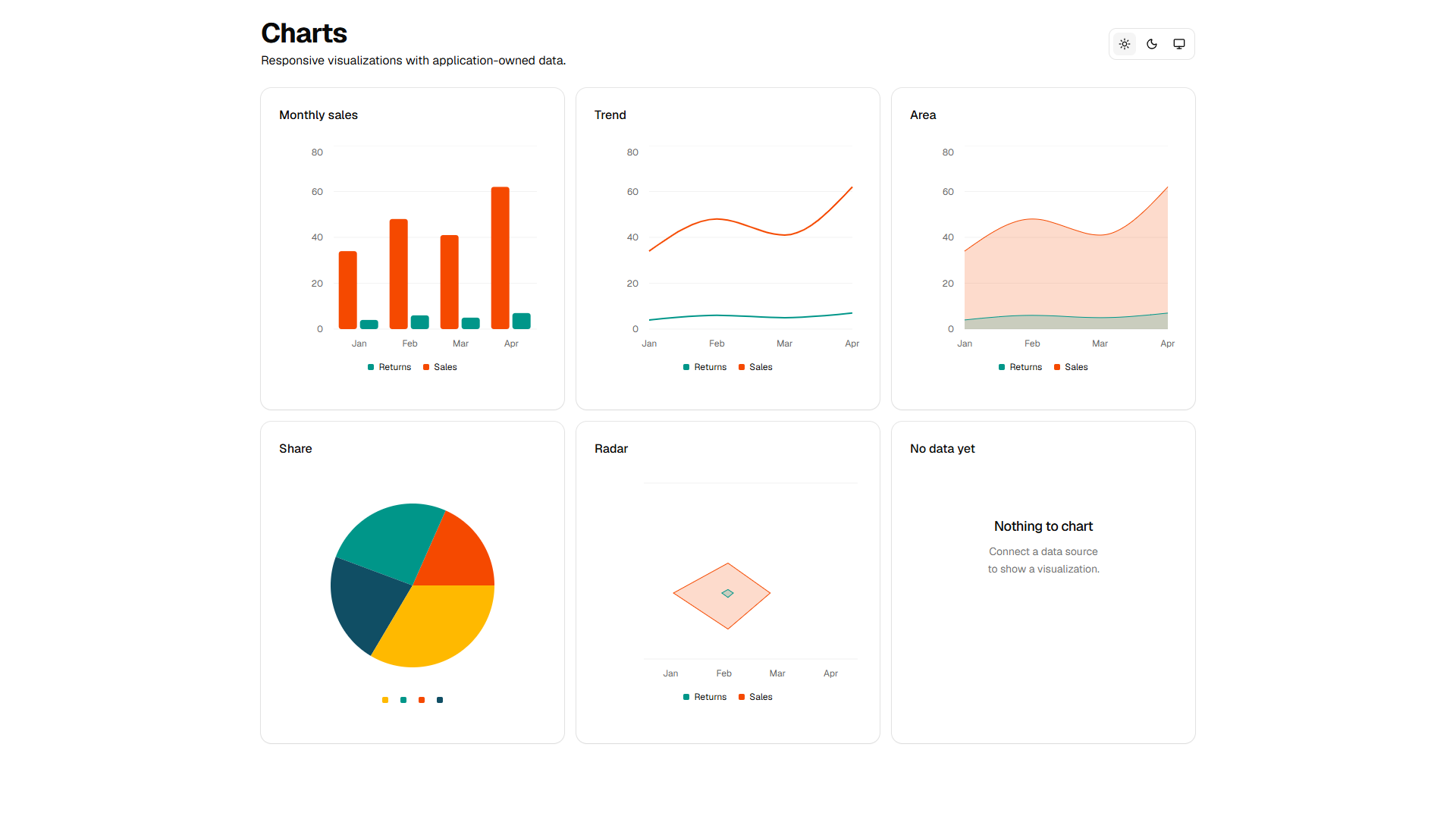
- python developers can build web applications using pure python.
- the renderer uses shadcn/ui design conventions, tailwind css, and base ui.
- components are strictly typed and validated across the protocol.
- reactive session state, async event handlers, and incremental patches.
| feature | shadlet | typical python web ui |
|---|---|---|
| rendering | react + shadcn/ui-based components | server-rendered templates |
| state | reactive session state | request/response state |
| components | built-in shadcn/ui-based component library | custom widget sets |
| packaging | python wheel with bundled renderer | manual frontend build |
- typed python component api with enums and validation
- built-in components based on shadcn/ui base-vega
- complete generated lucide icon catalogue with a python namespace
- official bundled geist variable & geist mono typography
- smooth animations, backdrop blur, and spring physics
- automatic port switching when default port is occupied
- hot reload with diff-based patches
- session-scoped reactive state
- async event handlers with cancellation
- pydantic v2 form submission validation with reactive field errors
- server-driven data table pagination, sorting, search, and validated queries
- reactive data table loading/error states, retry controls, per-column filters, and column visibility
- session-owned async background tasks with reactive progress and cancellation
- multipart http uploads with per-request size limits and app authentication
- typed query-parameter state synchronized with browser history
- separately packaged react extensions discovered from python entry points
shadlet extension create,build,check, andinfocommands- local upload storage with safe keys, atomic writes, and size limits
- versioned json protocol with incremental patches and shared pydantic/zod fixtures
- validated websocket handshake, token-based session restoration, and origin checks
- configurable connection authentication, event rate, payload, message, and render-tree limits
- typer and rich cli
- github project templates
- mkdocs documentation website
requirements:
- python 3.11 or newer
node.js is only required for maintainers building the renderer from source. installed python extensions load their bundled browser assets without node or npm.
pip install shadletfor development from source:
uv pip install -e '.[dev]'verify:
shadlet doctor
shadlet infocreate a project:
shadlet create my-app
cd my-app
shadlet dev
or write main.py directly:
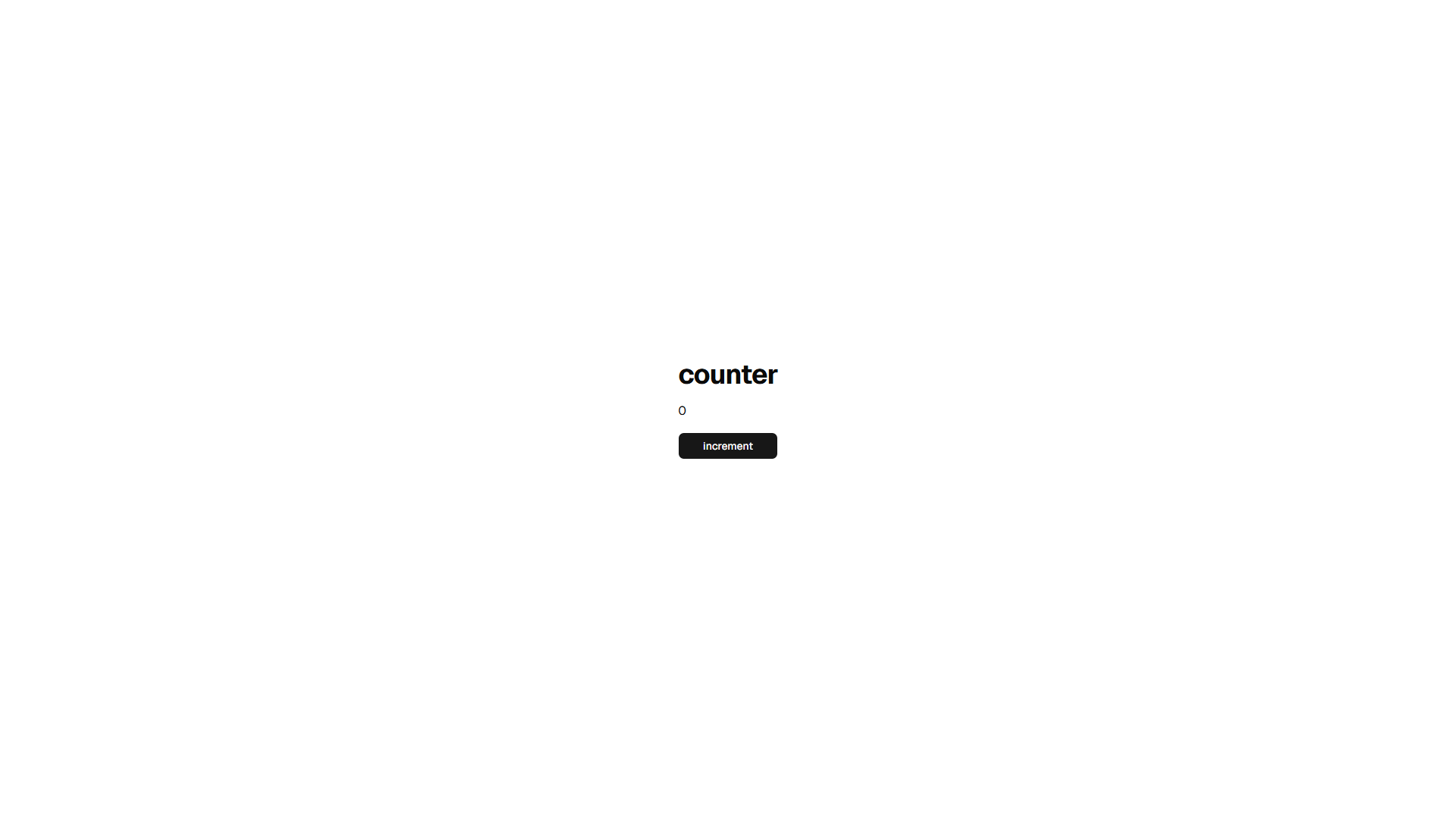
import shadlet as ui

app = ui.App("counter")


@app.page("/")
def home(ctx: ui.Context):
    count = ctx.state(0, key="count")

    def increment(event: ui.ClickEvent):
        count.value += 1

    return ui.Center(
        ui.Column(
            ui.Heading("counter"),
            ui.Text(count),
            ui.Button("increment", on_click=increment),
            gap=16,
        ),
        min_height="100vh",
    )


if __name__ == "__main__":
    app.run()
run:
python main.pyopen http://127.0.0.1:8000.
flowchart LR
  A[python application] --> B[component api]
  B --> C[validation and normalisation]
  C --> D[versioned json protocol]
  D --> E[react renderer]
  E --> F[browser]
- python handles application logic.
- react handles rendering.
- communication uses a versioned json protocol over websocket.
shadlet/
  packages/python/shadlet   python runtime
  packages/renderer         react renderer
  templates                 project templates
  examples                  example applications
  tests                     python tests
  docs                      documentation
- runnable examples and learning path: state, forms, routing, components, responsive layouts, tables, charts, background tasks, storage, multipart uploads, icons, and deployment.
install shadlet from the repository root, then start an example:
python -m pip install -e .
cd examples/counter && python main.pythe repository includes ten task-specific agent skills for building apps, designing interfaces, authoring components and extensions, debugging, contributing, review, testing, releases, and migrations. canonical skills are shared across codex, cursor, gemini cli, and github copilot; claude code and copilot code review receive validated mirrors.
full documentation is in docs/ and built with mkdocs. the agent skills guide describes the included workflows and host discovery locations.
the python extension, upload, query-state, and browser testing apis are documented in their guides. see limitations for the verified scope and remaining boundaries.
python -m mkdocs serve
python -m mkdocs build --strictclone and set up:
git clone https://github.com/programmersd21/shadlet
cd shadlet
uv venv --python 3.11
uv pip install -e '.[dev]'
cd packages/renderer && npm ci
checks:
ruff check .
ruff format --check .
mypy .
pyright packages/python/shadlet
pytest
cd packages/renderer && npm run lint && npm run format:check && npm run typecheck && npm run test && npm run build
python -m mkdocs build --strict- python 3.11 or newer
- browsers: current evergreen browsers
shadlet is developed by human maintainers with assistance from ai tooling. ai assistance is used for drafting, refactoring, documentation, and review support. all code is reviewed by maintainers and must pass the project's lint, type, test, and build checks before release. see contributing for the ai code policy.
mit licensed. see license for full details.
see limitations for the verified support matrix and capabilities.