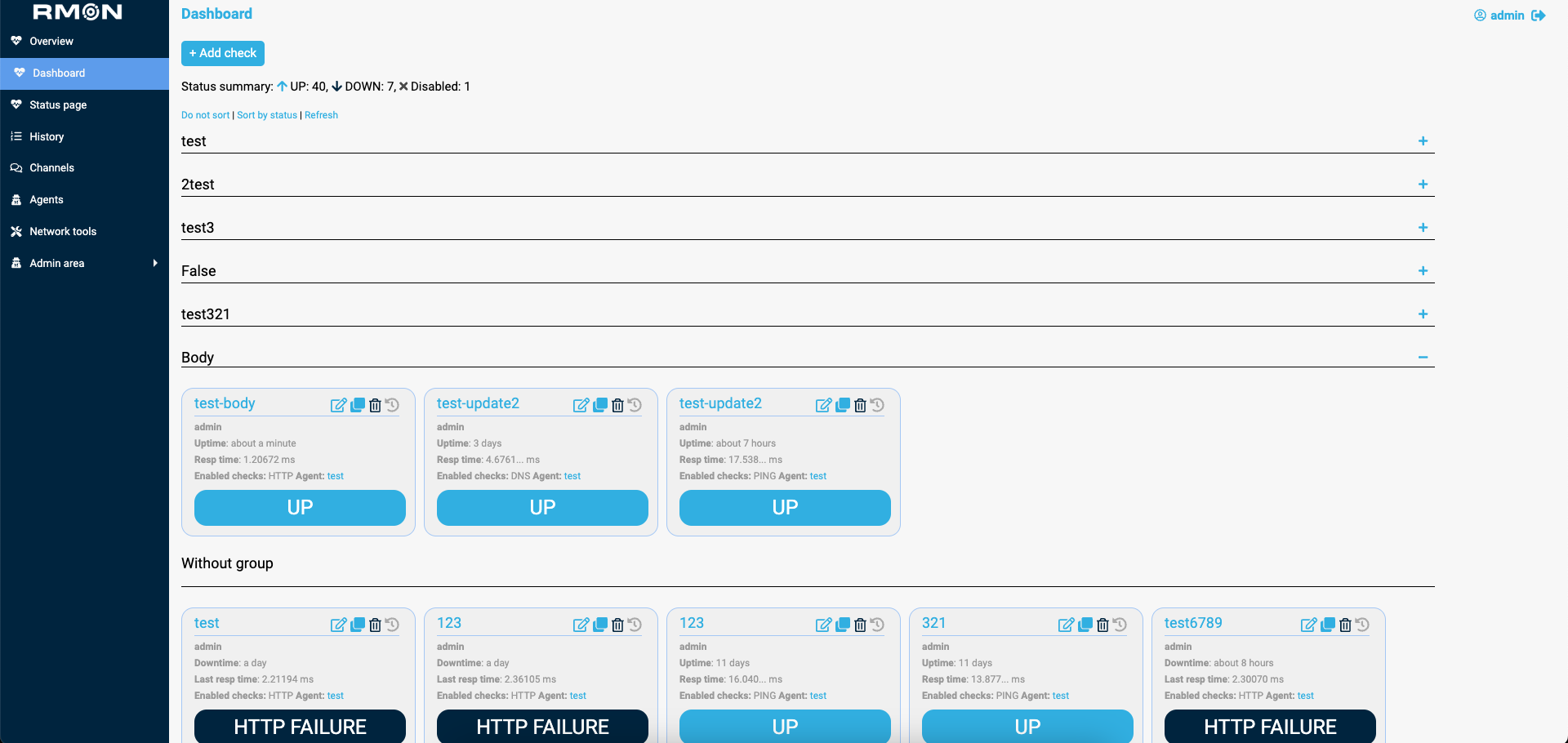
RMON (remote monitoring) is an easy to understand and use geo-distributed monitoring.
- Telegram Channel about RMON, talks and questions are welcome
- Checking ping availability
- Checking DNS records availability
- Checking the availability of TCP and UDP ports
- Checking HTTP statuses
- Checking the BODY of HTTP(s) responses
- Checking the SSL expiration date
- Checking SMTP service
- Checking RabbitMQ service
- Sending Telegram, Slack, PagerDuty and Email notifications
- Real-time alerting via RMON web interface
- Checking network connectivity
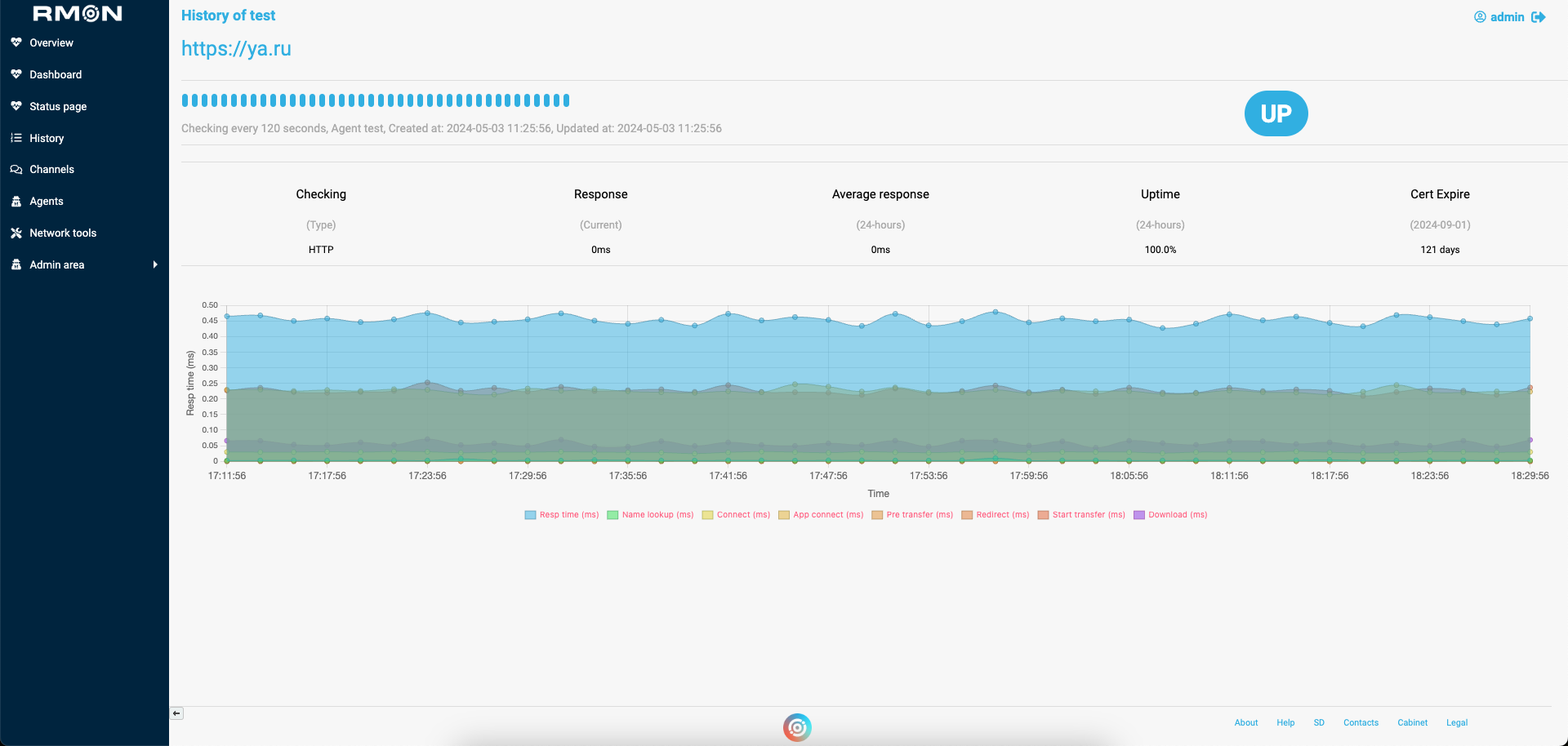
- Providing information upon response time
- Providing information upon servers uptime and downtime
- Storing the alarm history
- Storing the history of events for each host
- Status pages
- RMON Agents
- Network tools
For installation on EL and Ubuntu read this guide
RMON no longer ships reusable application or credential-encryption secrets. Set these values in the service environment before starting RMON:
RMON_SECRET_KEY: a random value of at least 32 characters for Flask sessions.RMON_SECRET_PHRASE: a Fernet key for stored SSH passwords, passphrases, and private keys. Generate one withpython3 -c "from cryptography.fernet import Fernet; print(Fernet.generate_key().decode())".RMON_JWT_PRIVATE_KEY_FILEandRMON_JWT_PUBLIC_KEY_FILE: optional overrides for the default JWT key paths in/var/lib/rmon/keys.
The Flask secret may instead be stored in RMON_SECRET_KEY_FILE; when neither setting exists, RMON creates /var/lib/rmon/keys/flask-secret with mode 0600. The scheduler itself remains enabled by default, but its unauthenticated REST API is disabled. Set RMON_SCHEDULER_ENABLED=0 when a separate scheduler process is used.
To rotate an existing credential key, back up the database and run rotate_credential_secret.py with both RMON_OLD_SECRET_PHRASE and the new RMON_SECRET_PHRASE in the environment. The update is transactional and can safely skip values that were already rotated.
Super administrators can configure one or more OIDC providers under Admin area → OIDC. RMON supports discovery metadata, signed ID-token validation through JWKS, optional UserInfo claims, verified-email and domain policies, automatic user creation or email linking, and external-group mappings to RMON groups and roles. Local and LDAP login remain available.
Set RMON_PUBLIC_URL=https://rmon.example.com when RMON is behind a reverse proxy so the generated callback URL uses the public origin. Register the displayed /oidc/<provider>/callback URL in the identity provider and include at least the openid scope. OIDC client secrets are encrypted with RMON_SECRET_PHRASE and are included in rotate_credential_secret.py rotations.
Subscription checks are centralized in app/modules/subscription/access.py, following the Roxy-WI entitlement model. The catalog covers OIDC, action history, monitoring history, alert history, alerting channels, status pages, monitoring check and agent limits, and service control.
All cataloged features are currently free. SUBSCRIPTION_ENFORCEMENT_ENABLED is intentionally set to False in the subscription module, so stored license status and plan values do not restrict access. When paid enforcement is ready, change that code constant to True; the existing feature policies, route guards, business-service checks, UI visibility rules, and plan limits will become active together.